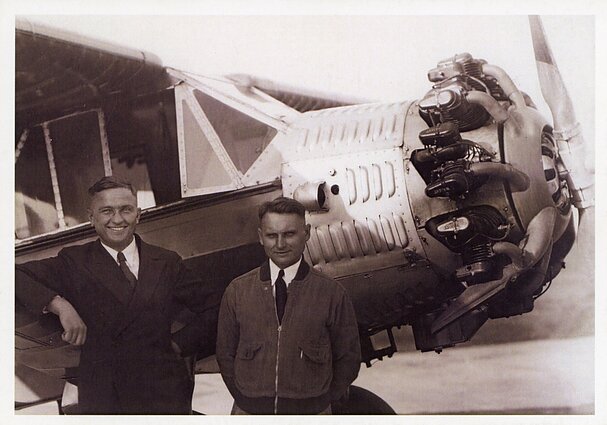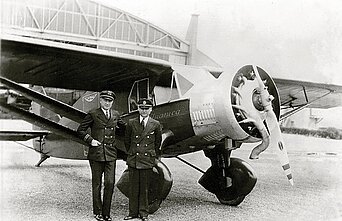
















On June 15, 1933, two talented pilots, Steponas Darius and Stasys Girėnas, took to the skies in a Bellanca-type aircraft from New York. Their goal was to cross the Atlantic Ocean and land in their homeland, but their attempt ended in a tragedy – both lost their lives. Their story continues to live on, solidifying the myth that it was the first attempt to fly across the Atlantic.
What do we know about the two men?
Darius was born in 1896 in what is now the Klaipėda district, in a village formerly known as Rubiškės, which was later named Darius in honour of the pilot.
"His father died when he was a child, so he went to America with his mother, brothers and sisters,” said Pijus Poškus, an author and curator at the Lithuanian Aviation Museum.
“He first lived in the New York area and later moved to Chicago. During the First World War, he volunteered for the United States Army and fought in France, where he was wounded in a rather dangerous mission as a telephonist, laying telephone cables across a battlefield. I think that this period of his life toughened him up a lot," said Poškus.
After returning to Lithuania in 1920, Darius first worked in the intelligence department, then, after graduating from military school, he became a lieutenant and served in military aviation from 1922 to 1927.
He also established the Lithuanian Aero Club in 1927, which encouraged the development of civil aviation. Until then, only military pilots were allowed to fly in the country.
After spending seven years in Lithuania, he decided to return to the US. Darius probably realised that he would have more opportunities in America, which was then experiencing the golden age of aviation, said Poškus.
Darius may have also developed a dream of crossing the Atlantic, which was probably sparked by the news of Charles Lindbergh's 1927 flight over the ocean separating the two continents that had captivated the world.
A gifted mechanic
Stasys Girėnas was born in 1893 in Vytogala, in what is now Šilalė district. He had a rough start to life – out of a large family of 16 children, only a few survived, while his parents also died early. Girėnas left for Chicago as a teenager.
His talent as a future pilot was revealed during his service in the US Army, where he was assigned as a mechanic.
"It became clear that Girėnas was a man with a great aptitude for technology. He also had a motorboat, which he used to ferry people on Lake Michigan, and was one of the first Lithuanians to set up a taxi company in Chicago,” said Poškus.
In the 1930s, as he became more established in the US, Girėnas started flying as an amateur, but in 1925 he had a serious accident that was even featured in newspapers of the time. However, this did not stop him.
"Everybody must have urged him to stop flying, but he returned to aviation. Although he was not a professional pilot, he was active and even won a prize for a precision landing,” said Poškus. “He was a really active amateur pilot, although he could not match the level of Darius, who was a professional military pilot who flew fixed-wing aircraft and also operated a Fokker triplane.”

Lituanica enters the picture
The real name of Girėnas is actually Stanistovas Tomas Girskis. According to the museum's curator, his first attempt to join the US military was unsuccessful, so when he went to another state he called himself Stanley Girch. When he was preparing for his flight across the Atlantic, he chose a Lithuanian name again.
"In 1932, Petras Jurgėla, who was in charge of Lituanica's propaganda – public relations, as they said at the time – suggested that the [two] surnames should ring well. He thought that Darius and Girėnas sounded better than Darius and Girskis or Darius and Girch, so the change was made before the flight," said Poškus.
The two men probably met in the summer of 1927 in Chicago, in a Lithuanian canteen owned by Darius' sisters.
It is likely, he said, that both men dreamt of crossing the Atlantic, but the main initiator and crew leader, navigator, and project manager was Darius, who had more professional experience.
"If Darius was the generator of ideas, [...] the quiet and entrepreneurial Girėnas helped to make them come true," added Poškus.
It is also a myth that Darius and Girėnas were the first to fly across the Atlantic. Six years had already passed since the first flight, although such long-distance plane journeys were still very rare. Nevertheless, this event had a special significance for the young Lithuanian state.

Darius and Girėnas chose a six-seater Bellanca passenger aircraft for their Atlantic dream. Aircraft of such type had successfully crossed the ocean before.
"Darius had flown this type of aircraft while serving in the Chicago suburbs, so it was very familiar to him. It is also easier to modify. In terms of value for money, it was the most suitable aircraft,” Poškus said.
One Lithuanian-American suggested naming the plane Litvega, there were also suggestions to dedicate the plane to Lithuania’s dictator at the time, Antanas Smetonas.
In the end, it was a journalist, Antas Vaivadas, who suggested the name Lituanica, “a somewhat of a Latin form of Lithuania”, said Poškus.
It is difficult to assess what Darius thought of Smetona, who had become an authoritarian leader of Lithuania after he was installed at the post by the military during the 1926 coup. According to Poškus, military aviators contributed to the overthrow of the government. Darius himself had taken part in the seizure of the post office as well as the presidency and the Seimas buildings.
"He was against the government of Kazis Grinius and the majority in the Seimas at the time,” said Poškus. “What is known is that when he came to America, he was criticised for his participation in the coup, because the Lithuanian-Americans probably already had a slightly different view of democracy.”

What caused the crash?
According to Poškus, the smooth preparations for the flight were disrupted by the divisive mood in society as a result of the coup in Lithuania.
Darius and Girėnas set up a special committee and tried to bring together prominent public figures. However, the museum official added, there were to derail the pilot’s attempt.
"One newspaper wrote that Baltrūnas, a Lithuanian pilot, would be flying across the Atlantic and that he was not asking for any support,” said Poškus.
Although the news was fake, the pair worried it might damage their attempt to gather the money needed to fund the flight. They were also worried there may indeed be another Lithuanian who was planning a similar flight.
"On the afternoon of July 14, the meteorologist, who at the time was mentoring all the pilots flying across the Atlantic, reported that the weather was good, so preparations for the flight began,” said Poškus.
“On July 15, pilot Wiley Post took off from Floyd Bennett Airport in New York. In the morning they were warned that a storm was forming in Europe. While Post was flying a much more modern plane and landed in Berlin in a much faster time, Darius and Girėnas realised that they would run into the storm somewhere in Europe. Of course, they could have changed their decision, but perhaps public and media pressure had its effect," added Poškus.
To save money, the pilots did not have adios and parachutes. The only safety feature in the Lituanica plane was the fuel dumping system, so in the event of an accident, for example, if the plane landed on the water, the fuel would be emptied so that the plane could float on water for a while.
"Girėnas was more in favour of safety features, but in the end, he succumbed to the leadership of Darius," said Poškus.
The flight took about a year to prepare, and the route was carefully planned, but it is still not known exactly where Lituanica reached Europe – over Scotland or southern England.

"The flight's subsequent course is rather vague because there is not enough data on the flight charts. However, it is known that Lituanica encountered a storm on the current German-Polish border, so it turned back a bit and flew towards Berlin, not Kaunas,” said Poškus.
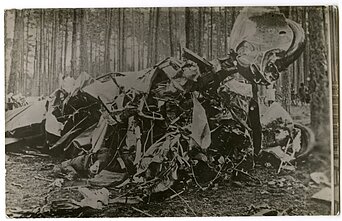
And although Lituanica successfully crossed the Atlantic, flying 6,460 kilometres in total, it never made it to Kaunas, the capital of interwar Lithuania. On July 17, the plane crashed in eastern Germany, some 600 kilometres from its destination.
“It is likely that they sought a landing sight due to an engine failure. They hit trees while flying very low. They were unprepared for such a landing at night and did not have a landing light, [but] it is difficult to say what exactly happened,” said Poškus.
However, the story pushed forth by the KGB during the Soviet era can be dismissed – the pair were not shot down by the Germans, said Poškus.
"Everybody tended to look around for someone to blame and failed to appreciate that the pilots themselves had made a mistake somewhere," he said.
An official investigation led by Antanas Gustaitis, the future chief of Lithuanian military aviation and the creator of the Lithuanian ANBO military plane, denied the rumours that the Lituanica had been struck by the Germans.
This version was also rejected by the military medical experts who examined the bodies of the pilots brought back to Kaunas. However, the downed plane was looted, so only part of it reached Lithuania. Black boxes help to detect crashes in modern planes, but they did not exist back then.
Asked whether the safety measures that the pilots refused to take would have helped avoid the accident, Poškus explained that radio communication could have been useful, but even with parachutes the pilots would not have escaped, as the crash happened at a low altitude.
"Darius and Girėnas died as human beings but were reborn as legends. We carry this beautiful story of the pursuit of modernity and the desire to make Lithuania famous to this day,” said Poškus.

Newsletter
Every Friday morning.